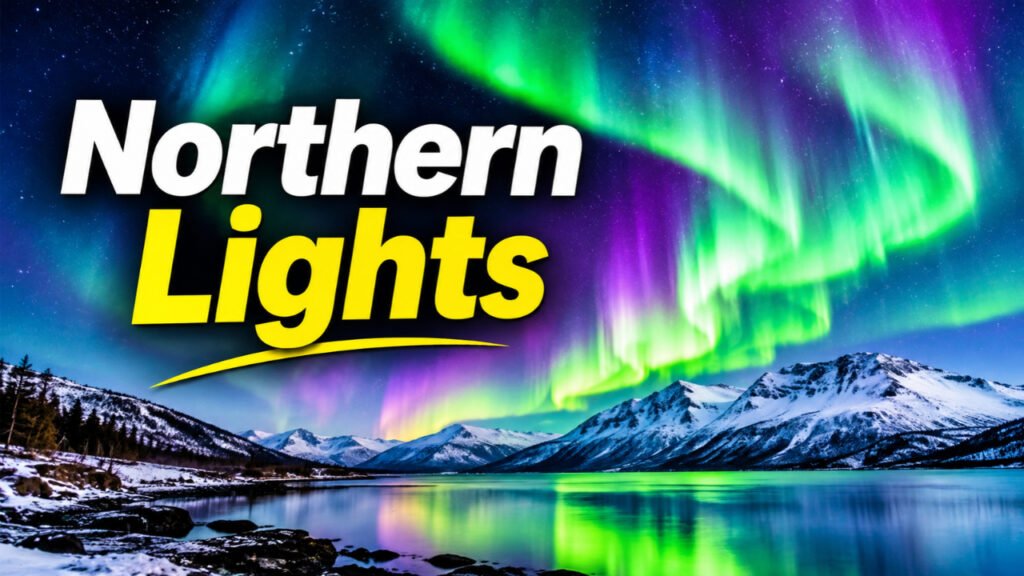
The Northern Lights (aka Aurora Borealis) are one of the most amazing natural sights that can be seen from Earth. These lights form a colorful display of light that moves across the night sky. The colors of the lights include green, pink, purple, red, and blue. People from all over the world come to see these spectacular views of nature.
But how are these mysterious lights created? And why do you find them in some areas of our planet, and which times of year would give you the most likely chance to see them? We’ll cover everything there is to know about the Northern Lights.
What Are the Northern Lights (Aurora Borealis)?
The Aurora Borealis is a form of natural light that appears in the Earth’s upper atmosphere, primarily over the Arctic region. This is caused when electric charges from the Sun react with gases in Earth’s atmosphere.
These interactions produce colorful waves and glowing patterns that travel across the night sky. The lights can be seen as curtains, arcs, spirals, or shimmering bands.
The scientific designation of the Northern Lights is Aurora Borealis. The name Aurora derives from the ancient Roman deity of dawn, whereas the term Borealis refers to a Greek word that means “northern.”
The same type of event happens in the southern hemisphere and is referred to as either the “aurora australis” or the “southern lights.”
What Causes the Northern Lights?
The northern lights are primarily created through solar activity and the Earth’s magnetic field.
Here is how the process works:
- Solar Wind Activity: The Sun continuously releases charged particles into space through what is referred to as the solar wind.
- Earth’s Magnetic Field: After the particles have reached Earth, most of them will be guided toward the poles by the Earth’s magnetic field.
- Atmospheric Interaction: The charged particles collide with oxygen and nitrogen atoms and molecules in the upper atmosphere.
- Energy Release: These collisions transfer energy to atmospheric gases. When the gases release that energy, they produce visible light.
This creates the vivid color displays we know as the Northern Lights.
Sometimes when a solar storm occurs, or when a large amount of plasma (or gas) erupts from the Sun (a CME), the amount of aurora activity increases. As a result, people in places further south than where the Northern Lights are normally seen may be able to see them.
Why Do the Northern Lights Have Different Colours?
The variety of colors that can be found in the Aurora Borealis is one of the coolest parts of this natural phenomenon. The color depends on what types of gases are present in the air and how high above Earth those gases collide with each other.
| Colour | Main Cause |
| Green | Oxygen at around 100–150 km altitude |
| Red | Oxygen at higher altitudes, generally above 200 km |
| Blue | Nitrogen molecules |
| Purple | Nitrogen emissions |
| Pink | A mixture of atmospheric emissions, often involving nitrogen |
Where Can You See the Northern Lights?
The Northern Lights are most commonly visible in areas close to the Arctic Circle. These destinations offer dark skies, relatively low light pollution, and favourable geographical conditions.
Some of the best places to experience the Aurora Borealis include:
| Destination | Country |
| Tromsø | Norway |
| Reykjavik and surrounding regions | Iceland |
| Rovaniemi | Finland |
| Abisko | Sweden |
| Fairbanks | Alaska, USA |
| Yellowknife | Canada |
| Ilulissat | Greenland |
When Is the Best Time to See the Northern Lights?
The best time to view the aurora borealis is usually from September through March in the Northern Hemisphere.
In the wintertime, the night is long and dark, so you will have more opportunity to see the Northern Lights.
Here are some useful viewing conditions:
- Best Months: September to March.
- Best Time: Late evening to early morning, often between 10 PM and 2 AM.
- Weather: Clear skies with minimal cloud cover.
- Location: Areas away from city lights.
- Solar Activity: Higher geomagnetic activity can improve visibility.
Although the most common time of the year that people travel north to view the Northern Lights is during the winter months, auroras may actually be seen any month of the year. However, it is very hard to observe them during the summer months in the northern latitudes because there is so much daylight.
Can You See the Northern Lights from India?
Generally, the Northern Lights cannot be seen in India due to its location well outside of the normal area where the Aurora Borealis can be viewed.
On rare occasions, when there are particularly strong geomagnetic storms, auroras may appear in areas of the world that are typically located closer to the equator.
Events of this type do not happen very often, so it is unlikely that you will see these kinds of sightings in India on a consistent basis.
In order for people in India to see the aurora borealis, they must go to places like Norway, Finland, Iceland, or Alaska.
Are the Northern Lights Dangerous?
The Northern Lights do not pose a danger to individuals who view them from the ground.
They exist very high up in the atmosphere of Earth, typically from about 80 to 500 kilometers above ground level. They do not emit enough harmful radiation to be a threat to the health of those viewing them.
However, the same types of solar storms that produce the most spectacular auroras may also interfere with satellites, radio signals, navigation systems, and electrical power grids.
Ordinary travelers can watch the northern lights safely as long as they follow the usual precautions for being outdoors and in cold weather.
Northern Lights vs Southern Lights: What Is the Difference?
The Northern Lights and Southern Lights are essentially the same natural phenomenon. The main difference is where they occur.
| Feature | Northern Lights | Southern Lights |
| Scientific Name | Aurora Borealis | Aurora Australis |
| Location | Northern Hemisphere | Southern Hemisphere |
| Common Viewing Areas | Norway, Iceland, Finland, Alaska | Antarctica, Tasmania, New Zealand |
| Best Season | September to March | March to September |
| Cause | Solar particles interacting with atmospheric gases | Solar particles interacting with atmospheric gases |
Both phenomena are produced by interactions between charged solar particles and Earth’s atmosphere.
Frequently Asked Questions
1. What is the Northern Lights phenomenon?
The Northern Lights are natural colourful light displays in the upper atmosphere. They occur when charged particles from the Sun interact with oxygen and nitrogen gases around Earth.
2. Why are the Northern Lights green?
Green auroras are mainly produced when charged particles collide with oxygen atoms at altitudes of approximately 100–150 kilometres.
3. What is another name for the Northern Lights?
The Northern Lights are scientifically known as the Aurora Borealis. They are also commonly called polar lights.
4. Which country is best for seeing the Northern Lights?
Norway, Finland, Iceland, Sweden, Canada, and the United States (Alaska) are among the popular destinations for viewing the Northern Lights.
5. Do the Northern Lights happen every night?
Auroras occur frequently in polar regions, but their visibility depends on solar activity, darkness, weather, and atmospheric conditions. Therefore, they cannot be guaranteed every night.
6. Are the Northern Lights visible during summer?
Auroras can occur during summer, but long daylight hours in Arctic regions make them difficult or impossible to see against the bright sky.
Conclusion
The Northern Lights (Aurora Borealis) are a beautiful display created by the interaction of charged particles coming from the Sun and gases in Earth’s atmosphere. The colors of the lights provide an excellent illustration of how Earth interacts with space.
From the green curtain of Norway to the colorful sky of Iceland and Finland, the aurora borealis is still drawing people from all around the world to see it. While when you will be able to view the aurora borealis depends on the weather and solar activity, seeing this amazing phenomenon is an experience that you’ll remember for the rest of your life.
Also Read: Northern Lights Tour and Packages | Northern Lights Glow